Nana
The Box ManNana occupies two overlapping roles in the practitioner’s account of the clinic: she is the Army Medical Captain’s legal wife, yet she lives with and works beside the man who has taken the Captain’s name. Her nursing and accounting work make her central to the clinic’s daily operation, while her relationships with both men place her at the center of its private and professional arrangements.
Identity and Background
The practitioner describes Nana as his common-law wife, although she was legally married to the Army Medical Captain whose name and identity he had borrowed for medical practice. He says he and Nana lived together with the Captain’s knowledge and approval, and that their arrangement caused no trouble for a time. The account thus distinguishes legal marriage from shared domestic life without suggesting that Nana’s role was merely private: she helped nurse the practitioner’s work and was responsible for the accounts.
Work at the Clinic
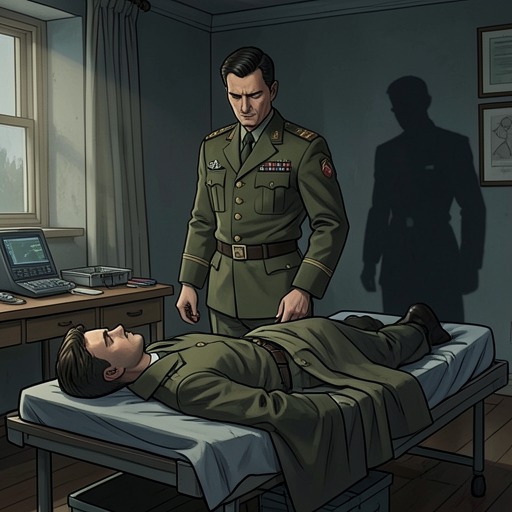
Nana’s work joined patient care to the clinic’s administration. The practitioner says that during the war he had served as a medical corpsman and later worked in a clinic with the Captain, whose drug dependence left him unable to conduct examinations or treatment. In the practitioner’s version, Nana managed the accounts while the practitioner handled medical work under the Captain’s identity. Patients’ trust and the practitioner’s confidence in his own skill helped the practice continue, but neither substituted for legal authorization; his affidavit ultimately acknowledges that practicing under another man’s qualifications was unlawful.
Relationships and Separation
The practitioner says that he and Nana became intimate after she had already been living with him as his partner. He also claims that the Captain, fearing the practitioner would leave, repeatedly pressured Nana to establish a relationship with him as a way of keeping him at the clinic. This explanation comes from the practitioner’s own affidavit, in which he accepts responsibility for continuing the illegal practice while describing the pressures surrounding it.
Their domestic arrangement changed after Toyama Yoko joined the clinic as a nurse apprentice. The practitioner says Nana was unhappy about the new appointment and suggested that they live apart; he agreed, and they had been living separately by the time of his statement. Elsewhere, an exchange about a nurse who left identifies her as the speaker’s wife and says she had become fed up with her part. Read alongside the account of Nana’s marriage and clinic work, the exchange reinforces the strain between her assigned role and the relationships built around the practice, though it does not independently explain every circumstance of her departure.
Influence on the Clinic’s Course
Nana also helped determine how the clinic presented itself to the outside world. According to the practitioner, as the Captain’s speech and conduct became conspicuous and the clinic faced scrutiny over its drug use, the Captain stopped appearing at public events. At Nana’s suggestion, the practitioner registered himself as the Captain. The change preserved the existing arrangement in which the practitioner treated patients while the Captain’s identity supplied the formal cover; it also made Nana’s practical influence part of the mechanism sustaining the deception.
The practitioner later says that he no longer had an obligation to continue deceiving the public and admits that impersonating a qualified doctor was a crime. His account makes Nana’s role significant without resolving her own judgment of the arrangement: she is shown nursing, managing the books, proposing separation, and advising a change in the clinic’s public representation, but the evidence does not give her an independent explanation of those choices.